
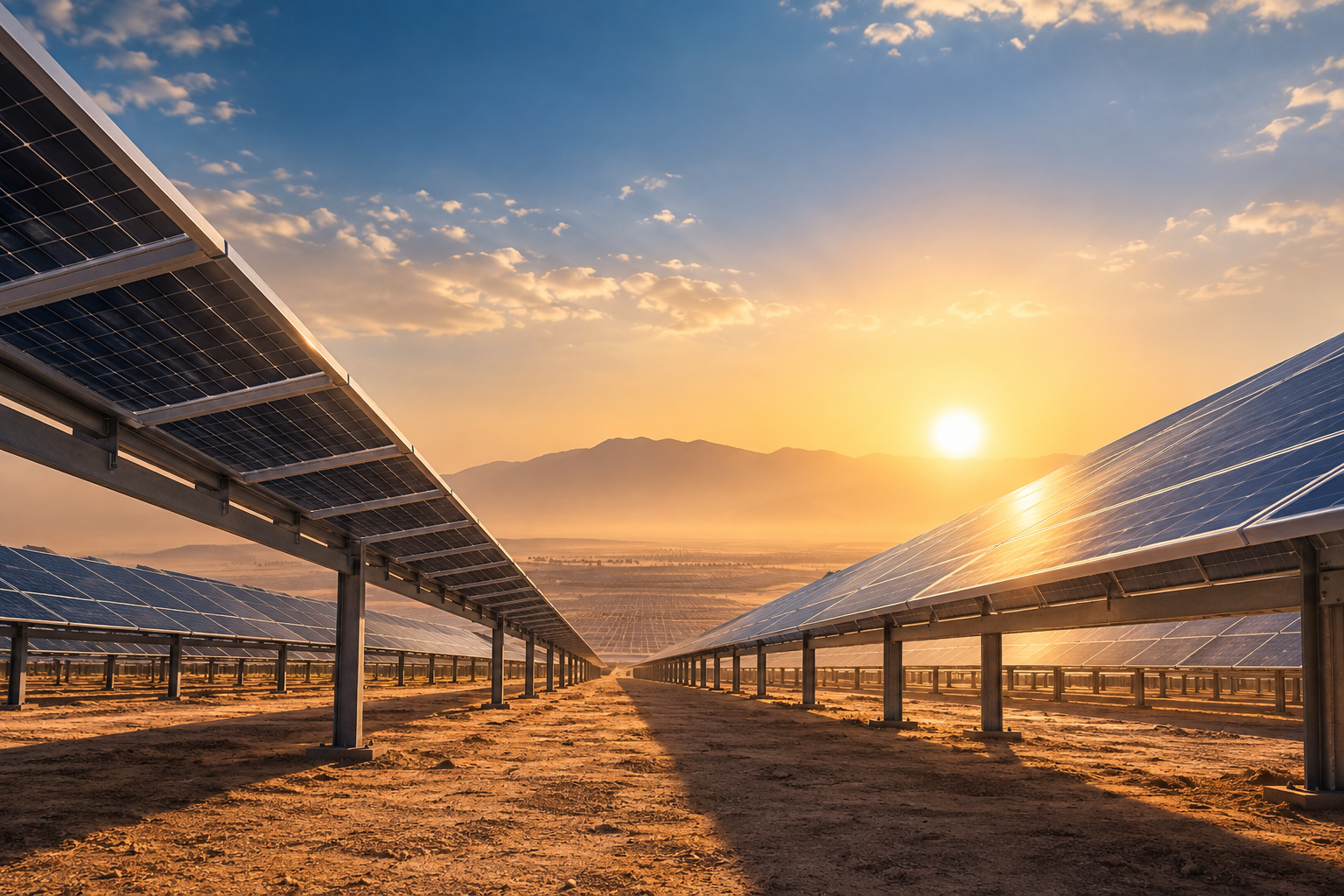
Climate change’s effects are a lot more prevalent in areas with extreme climates. The numerous events, such as wildfires, flash floods, and heatwaves, represent a challenge at the national level for economies and public policy frameworks. Many projects have been developed, and to date, they represent the central international pillars of the “green transition” we are facing today.
As a response to this climate emergency we have observed an increase in solar energy, especially from photovoltaic (PV) installations, as a means of reducing fossil fuel consumption while tackling global challenges such as energy poverty, climate change adaptation, and sustainable development. These have been incredibly popular in countries with high solar irradiance, however, PV systems still face several limitations, mainly caused by climate and meteorological conditions specific to each region. For instance, several studies have observed up to 60% energy loss for PV systems in regions with high dust or pollution levels, introducing significant uncertainty in energy forecasting and highlighting the need for research to improve these systems.
Many studies have observed the negative impact aerosol properties have on cloud microphysics, lifetime and albedo. They alter cloud reflectivity and precipitation potential, significantly affecting downward solar radiation, while decreasing solar irradiance reaching PV panels, ultimately increasing the diffuse component. To avoid cloud reflectivity, scientists have come up with a method called Bifacial photovoltaics (BPVs), which “harvests” irradiance from both sides of the front and rear panel, increasing total energy output, especially in locations with high diffuse radiation and albedo. This new bifacial approach is expected to rise from 20% growth in 2020 to 70% in 2030, driven by its superior performance vs the previously used technology. To date, bifacial solar farms are increasingly popular in places like the Middle East and South America, but are also booming in Western Macedonia, NW Greece and Mediterranean regions. Studies have confirmed that solar panels consume 99% less water and produce up to 90% fewer pollutants than coal-based energy systems. The need for the establishment of a global sustainable economy is growing, and the only way to do so is to rely on a constant and green energy source.
To evaluate how much power a solar farm can generate, satellite and climate data track the full spectrum of usable sunlight hitting the Earth from invisible ultraviolet rays and visible light to heat. By pairing this atmospheric light data with the size and efficiency of the solar panels, researchers can calculate total energy potential while measuring exactly how much sunlight is lost to cloud cover and floating air particles like dust and pollution.
To see how weather patterns and air quality have changed over time, a 20-year simulation (spanning 2004 to 2024) was conducted using the Kozani Sola Park as a baseline. Keeping the facility’s dimensions constant across all two decades even though the actual park was completed in 2022 allows for a direct comparison of how changing climate conditions affected power generation year after year.
Finally, these energy calculations were translated into real-world environmental and financial outcomes. Using standard emission tools, energy output was converted into equivalent carbon dioxide reductions to highlight environmental benefits in simple terms. Financially, total energy production was multiplied by the profit margin per kilowatt-hour, calculated as the selling price of electricity minus its production cost. This combined approach shows clearly how shifting skies directly influence both the green impact and the financial success of solar energy over time.
Using the same methodology in “How Much Sun” we are investigating the efficiency of another bifacial solar park in the Mediterranean region (Egypt), the Benban Solar park , relying on simulated solar energy output data from Copernicus Atmosphere Monitoring Service (CAMS) to evaluate solar irradiation for the years 2004-Today . This information will be used to deliver precise and updated information to forecast and nowcast the efficiency of the bifacial solar panels.
By applying this model to Egypt’s Benban Solar Park, “How Much Sun” is helping maximize solar performance in challenging desert climates. Precise, real-time tracking of dust and weather conditions will allow operators to boost power output, increase revenues, and build a more reliable clean energy grid for the region.